Best Attio Alternatives in 2026
On this page
Attio is a CRM software that builds records from your email and calendar and lets you shape the data model around how your business works. If you're comparing Attio alternatives, you've probably run into one of its plan limits, or you need something it leaves to another tool, like LinkedIn outreach.
We build Omniscient, a CRM that also runs LinkedIn outreach, and we built our own Attio importer, so we've worked with Attio's records and objects up close. This list starts from the limits on Attio's own pricing page and gives you the eight alternatives we'd shortlist in 2026, sorted by the reason you're leaving.
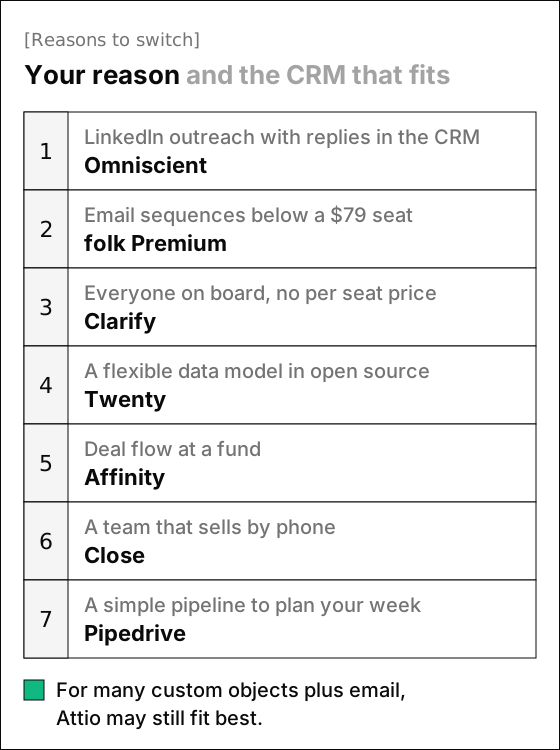
Our short answer, by the reason you're leaving:
- Pick Omniscient if you prospect on LinkedIn and want each reply on a CRM record that fills itself in.
- Pick HubSpot if you want a free CRM now and marketing tools on the same platform later.
- Pick folk if you're a founder or an agency and your deals start in your own network.
- Pick Pipedrive if your team plans its week around pipeline stages.
- Pick Twenty if you like Attio's flexible objects and want open source software you can host yourself.
- Pick Clarify if you want the whole team on board without paying per seat.
- Pick Affinity if you set up Attio to track deal flow at a fund.
- Pick Close if your team sells by phone.
| Tool | What it is | Starting price | Best for |
|---|---|---|---|
 Omniscient | A CRM that fills itself in, with LinkedIn outreach you approve | $19 per seat a month, billed yearly | Small B2B teams that sell through LinkedIn |
 HubSpot | A CRM platform with marketing, sales and service tools | Free for up to 2 users | Teams that want marketing and sales in one place |
| A light AI CRM with a LinkedIn extension and email sequences | $24 per member a month, billed yearly | Founders and agencies selling through their network | |
 Pipedrive | A sales pipeline CRM with an AI sales assistant | See site | Small teams that work by pipeline stage |
| An open source CRM with a data model you build yourself | $9 per user a month, billed yearly | Teams that want an open source data model | |
| An AI CRM priced by credits, with unlimited seats | Free, then $50 a month | Small teams that want everyone on board | |
| An AI CRM for private capital firms, built on relationship data | $2,000 per user a year | Investors tracking deal flow | |
| A CRM for calling, email and SMS, with an AI assistant | From $9 a month for one user | Teams that sell by phone |
What Attio does well
Attio still fits plenty of teams, so it helps to know what you'd give up. Its homepage now opens with "Welcome to agentic revenue," and it describes agents that route new leads and catch renewals before they slip. Its pricing page lists these today:
- Email and calendar sync and automatic enrichment come with every plan, Free included.
- Objects grow with the plan: 3 on Free, 5 on Plus, 12 on Pro and unlimited on Enterprise.
- Free sends up to 200 emails a month and Plus up to 1,000, and Pro removes the cap.
- Pro adds sequences, Call Intelligence, permission controls and advanced reporting.
- Eligible startups can get up to 80% off, and the trial gives you 14 days of Pro.
Honestly, if your process doesn't fit a standard CRM and someone on your team enjoys designing objects, Attio is hard to replace. Our Omniscient vs Attio comparison goes through the two feature by feature.
Why teams look for an Attio alternative
Every reason below comes from Attio's own pricing page, help center and app directory:
- Sequences and Call Intelligence start on Pro, at $79 per user a month billed yearly, or $99 monthly.
- Sequences send email only, and Attio's help center lists "cold or high volume sales outreach" among the uses they aren't meant for.
- Attio's sequences don't send on LinkedIn, so teams that prospect there add an app from its directory, such as HeyReach, which logs LinkedIn invitations and messages in Attio.
- AI runs on credits: seat credits go from 100 per user a month on Free to 2,500 on Enterprise, and workspace credits from 250 on Free to 10,000 on Pro.
- Another 5,000 workspace credits cost $70 or $85 a month, depending on billing.
- Free stops at 3 seats and Plus at 10, so an eleventh seat means moving to Pro.
These matter most for a small sales team, and for anyone who opens most conversations on LinkedIn.
The 8 best Attio alternatives in 2026
1. Omniscient
Omniscient is a CRM and LinkedIn outreach software that fills in your records from email, calendar and call transcripts, and sends only the LinkedIn messages your team approves. Otto, our AI agent, drafts those messages and the emails you send after a call, and he proposes field values with the quote behind each one.
Like Attio, Omniscient reads your inbox, and the hardest call we made was deciding when the AI may write to a record without asking you. Each field now follows these rules:
- You set every field to off, suggest or auto.
- A value with no quote behind it, or one Otto is less than 60% sure of, is dropped.
- An auto field fills itself only when it's empty and Otto is at least 85% sure.
- A value someone on your team typed is never changed, and a private inbox never fills a field on its own.
- Everything else waits in Suggestions, where you accept or skip it.
We made suggestions wait on purpose, because one wrong amount in a forecast costs more than an empty field. Fields filled with proof start on Pro, at $49 per seat a month billed yearly.
On the LinkedIn side, Scout finds leads from a sentence that describes who you want. It scores each lead out of 100: up to 60 for fit and up to 40 for signals that now is a good time.
We built the sending engine ourselves this year, and because LinkedIn's invitation limit page gives no number, each sender paces itself. At the Normal pace, a sender works like this:
- A new sender starts at 5 invitations a day and adds 2 a day until it reaches your limit.
- Each day's total lands somewhere between 80% and 100% of that limit.
- It works inside the sender's hours, with a lunch break and random gaps of 3 to 12 minutes.
- By default, it views the profile 1 to 4 hours before sending the invitation.
- It drops to half pace for 3 days when LinkedIn rate limits the account.
- It does the same when a week brings 20 or more invitations and fewer than 1 in 5 are accepted.
Replies land in one Inbox, with the person's CRM record beside each thread, and a reply stops that person's outreach in every campaign.
Admittedly, Omniscient is narrower than Attio in a few places. We have no mobile app and no email sequences, so Otto's email drafts go out only when you send them yourself. If your team sells mostly by email, Attio Pro or folk Premium will suit you better.
Teammates who only view or log data are free, and paid seats start at $19 per seat a month billed yearly. The trial lasts 14 days with no credit card, and the CRM page and the Outbound LinkedIn page show the rest.
2. HubSpot
HubSpot is a customer platform software that puts marketing, sales and service tools on one CRM. Its free CRM is "100% free with no expiration date" for up to 2 users and 1,000 contacts. It includes Breeze Assistant, which researches companies and preps you for sales calls.
- Sales Hub Starter shows a "starts at" price of $7 per seat a month for new customers, next to $20.
- Sequences start on Professional, according to HubSpot's own Sales Hub pricing guide.
- Professional starts at $90 per seat a month on a yearly commitment, plus a $1,500 onboarding fee you pay once.
- Paid plans include HubSpot Credits for AI, 500 a month on Starter and 3,000 on Professional, and extra credits cost $0.01 each.
- Included credits reset each month and don't roll over.
HubSpot suits a team that wants a free CRM today and expects to add marketing tools later. If sequences are why you're leaving Attio, plan on Professional. Our guide to the best CRM for startups compares HubSpot with other early stage picks.
3. folk
folk is an AI CRM software that tracks relationships and deals for sales and agency teams. Its browser extension, folkX, imports single people or whole lists from LinkedIn and Sales Navigator, and it also works on Gmail, WhatsApp, Instagram and X.
- Standard costs $24 per member a month billed yearly, or $30 monthly, and Premium costs $48, or $60 monthly.
- Email sequences, custom objects and dashboards start on Premium.
- Standard includes 2,000 magic fields a month, which are folk's AI fields, and a Workflow Assistant limit of 1,500 a month.
- Every plan has unlimited members, and the trial lasts 2 weeks with no credit card.
Interestingly, folk's Premium plan gets you email sequences for less than Attio's Pro seat. It suits founders and agencies whose deals start from LinkedIn conversations and their own network.
4. Pipedrive
Pipedrive is a sales pipeline CRM software that helps small businesses manage leads and close deals. Its AI Sales Assistant predicts which deals you're likely to win or lose and suggests which leads to pursue.
- Nova, its meeting intelligence, writes a brief before each call, records and transcribes it, and drafts CRM updates for you to approve.
- The homepage says Nova comes with every plan at no extra charge.
- The free trial lasts 14 days with no credit card.
- Its pricing page didn't load for us on November 3, so check today's plans there.
Pipedrive suits a team that wants a clear pipeline more than a custom data model. Thankfully, its CRM updates from calls wait for your approval, which is the same choice we made for suggested values in Omniscient.
5. Twenty
Twenty is an open source CRM software that gives you building blocks for your own data model and automations, in its cloud or on servers you run. Its site calls it "the #1 Open Source CRM on GitHub."
- Pro costs $9 per user a month billed yearly, with email and calendar sync, a custom data model and about 100 AI tasks a week per member.
- Organization costs $39 and adds custom roles with field and row permissions, plus SSO.
- You can host the open source core yourself for free, and the cloud trial lasts 30 days.
- Cloud workspaces include an MCP server for connecting AI assistants.
Twenty is the closest match here if you love Attio's flexible objects and want to own the code and the data. In return, expect to build more of the CRM yourself, and to look after the servers if you host it.
6. Clarify
Clarify is an AI CRM software that calls itself "the autonomous CRM," with an agent named Rep that drafts campaigns and enrolls leads in them. It syncs with your email and calendar and records every call.
- The Free plan costs $0 with unlimited seats, 1,000 credits a month, 20,000 records and one active campaign.
- Starter costs $50 a month for the whole team, with 5,000 credits a month, 250,000 records and five active campaigns.
- Clarify's own pricing example puts a meeting summary at 30 credits, and Starter credits don't roll over.
Luckily for small teams, adding a teammate never changes the bill. Watch the credits instead, since every summarized meeting draws from the same pool.
7. Affinity
Affinity is an AI CRM software that helps private capital firms, such as venture capital and private equity funds, find deals through their network. It captures your firm's emails and meetings automatically and scores how strong each relationship is.
- Essential costs $2,000 per user a year, billed annually, with relationship scoring and pipeline tracking.
- Scale costs $2,300 and adds meeting notes, chat with your pipeline, the Ascend agent platform and a hosted MCP server.
- Advanced costs $2,700 and adds enrichment from PitchBook, Dealroom and Crunchbase.
- We didn't see a free trial on its pricing page.
If you set up Attio to track deal flow at a fund, Affinity is built for that job and surfaces the warm path to a decision maker. For a startup sales team, it's more CRM than you need.
8. Close
Close is a sales CRM software that helps teams call and text their leads, with a dialer and SMS built in. Its AI assistant, Chloe, answers questions about your pipeline and your calls on every plan.
- Solo shows $9 or $19 a month for one user, depending on billing, and Essentials shows $35 or $49 per user.
- Growth adds workflows and the Power Dialer, and Scale adds the Predictive Dialer and live call coaching.
- Call Assistant costs $50 a month plus $0.02 a minute.
- The trial lasts 14 days with no credit card and includes $5 of calling and enrichment credits.
Frankly, Close is the one we'd pick for a team on the phone all day, since Omniscient has no dialer. Once you hit dial on a saved list, Close works through it on its own.
Attio alternatives compared
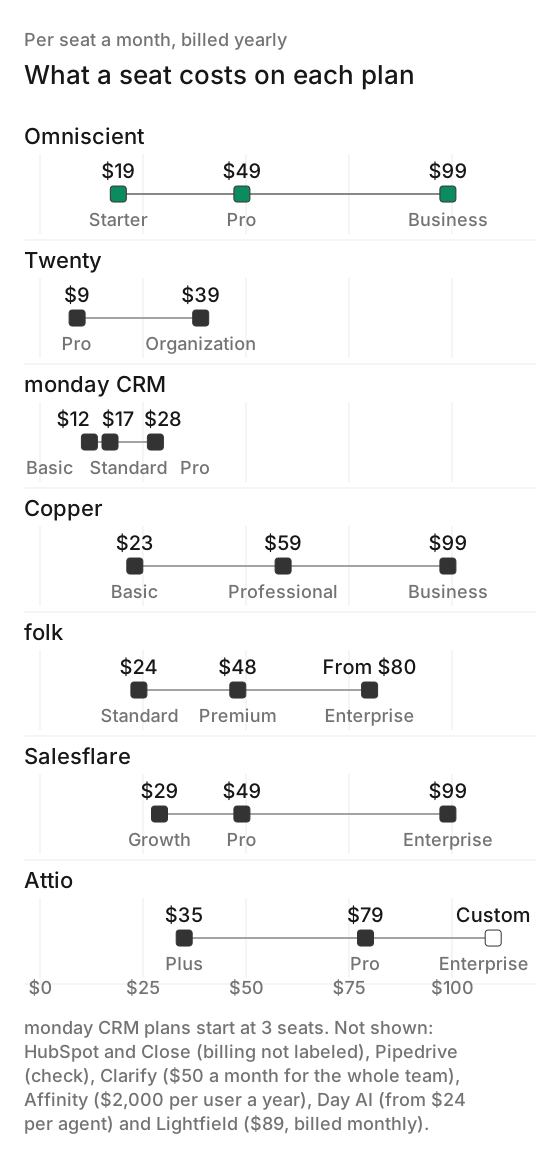
The chart shows what a seat costs on each plan, for the tools that publish a yearly price per seat. Attio's sequences start at $79, so compare your shortlist against Attio Pro if you need them.
Past the seat price, these differences sort the list fastest:
| CRM | Free plan | Free trial | How AI is priced |
|---|---|---|---|
| Attio | Up to 3 seats | 14 days of Pro | Seat and workspace credits |
| Omniscient | Free seats for teammates who view or log data | 14 days, no card | Included in the seat |
| HubSpot | Up to 2 users | Free plan instead | Monthly credits on paid plans |
| folk | Not listed | 2 weeks, no card | Monthly limits per plan |
| Pipedrive | check | 14 days, no card | Nova included on every plan |
| Twenty | Free if you host it | 30 days on the cloud | About 100 AI tasks a week per member on Pro |
| Clarify | Unlimited seats | Free plan instead | A monthly credit pool for the team |
| Affinity | Not listed | Not listed | Early AI features on Essential, agents from Scale |
| Close | Not listed | 14 days, no card | Monthly AI credits that don't roll over |
How to move from Attio to another CRM
Personally, we'd run the new CRM next to Attio for a couple of weeks before moving the team over, in this order:
- 01Connect your inbox first
Add Gmail or Outlook and your calendar to the new CRM while Attio keeps running, so its timeline starts filling.
- 02Export what an importer might skip
Save custom objects and lists as spreadsheets, since an importer may only read the standard records.
- 03Import the core records
Move companies, people, deals and notes, then check that each deal kept its stage and owner.
- 04Rebuild the custom parts
Recreate custom objects and fields in the new data model, then load the spreadsheets from step 2.
- 05Move automations last
Rebuild workflows and sequences once the data settles, so nothing fires on a half imported record.
- 06Give LinkedIn a slow start
A new Omniscient sender begins at 5 invitations a day and adds 2 a day, so allow a couple of weeks before you judge your first campaign.
In Omniscient, the importer reads companies, people, deals with their stages, and notes from Attio. People already in your workspace are matched by email and filled in, so a contact that came in through your inbox doesn't turn into a duplicate. People without an email address are skipped, so keep them in the spreadsheets from step 2.
Accounts, contacts, opportunities with their stages, and notes. Records already here are matched and filled in.
HubSpot
 Salesforce
 Attio
Pipedrive
Connect Attio
Attio2m ago, 1,240 accounts, 3,812 contacts, 214 opportunities, 960 notesDone
Attio's custom objects stay behind, so you rebuild them in our data model. If you'd rather not run the import yourself, we migrate your companies, contacts, deals and notes for you.
If none of these eight fit, our roundup of the best AI CRMs covers a few more.
Questions about Attio alternatives
What is the best Attio alternative?
That depends on why you're leaving Attio. Omniscient fits small teams that prospect on LinkedIn and want replies on the CRM record. HubSpot fits teams that want a free CRM with room for marketing, and Twenty fits teams that want a flexible data model in open source.
Is there a cheaper alternative to Attio?
Yes, several cost less than Attio's Plus plan, which is $35 per user a month billed yearly. Twenty starts at $9 per user, Omniscient at $19 per seat and folk at $24 per member, all billed yearly, and HubSpot and Clarify have free plans.
Is there a free alternative to Attio?
HubSpot's free CRM covers up to 2 users and 1,000 contacts, and Clarify's free plan has unlimited seats with 1,000 credits a month. You can also host Twenty's open source core yourself for free.
Does Attio have LinkedIn automation?
No, Attio's own sequences send email only, through your synced Gmail or Microsoft account. Teams that prospect on LinkedIn add an app from Attio's directory, or move to a CRM that sends on LinkedIn, like Omniscient.
Can I move my data from Attio to Omniscient?
Yes, our importer reads companies, people, deals with their stages, and notes from Attio, or we migrate them for you. Custom objects stay behind, so you recreate them in Omniscient's data model.